Face Mask Filtration: PM$_{2.5}$ and PM$_{10}$ Removal Efficiency
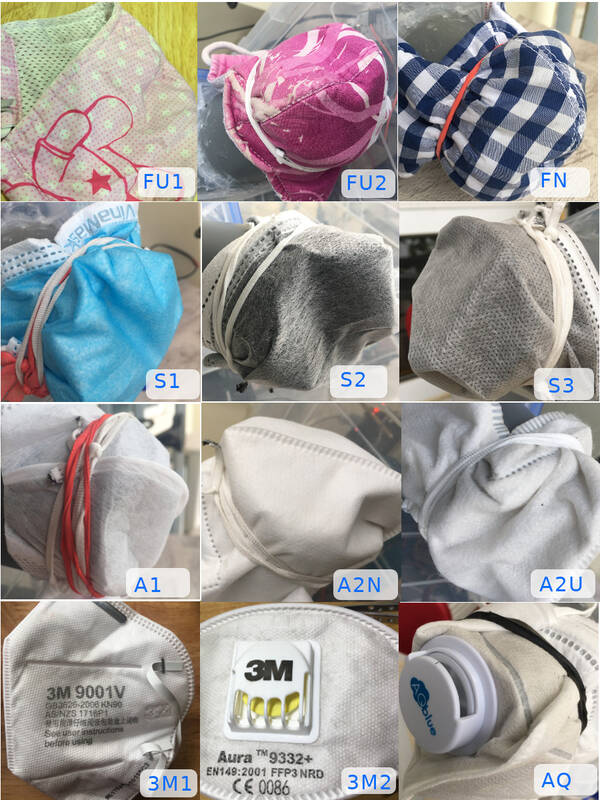
This study evaluated 11 masks over 55 days using an improvised testing apparatus with PMS7003 sensors. It measures material filtration efficiency only; face-seal fit was not evaluated.
Abstract
Four types of face masks were evaluated for particulate matter removal efficiency (RE): fabric, surgical, “air masks” (marketed for pollution), and brand-name particulate respirators. Masks were mounted on a 6 cm PVC pipe, and air was drawn through by a variable-speed fan. PM$_{2.5}$ and PM$_{10}$ were measured upstream and downstream using Plantower PMS7003 sensors.
Results by mask type:
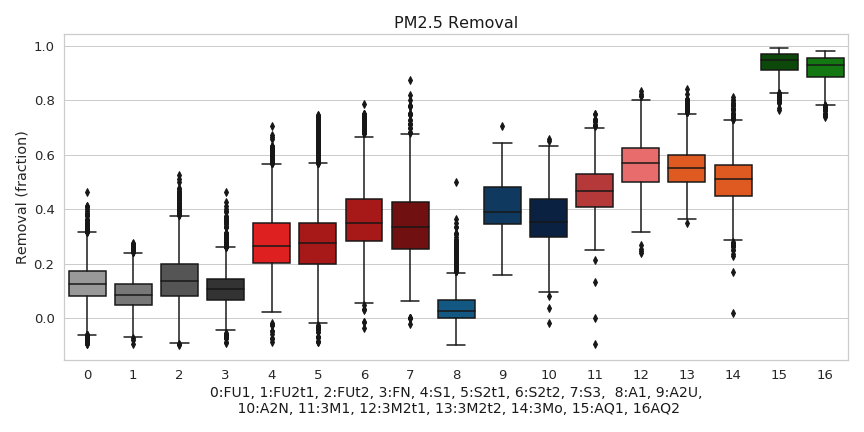
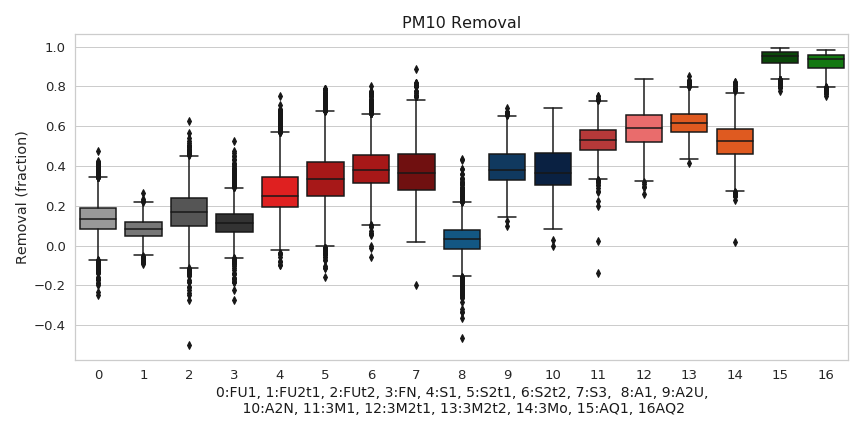
| Type | PM$_{2.5}$ Removal | PM$_{10}$ Removal |
|---|---|---|
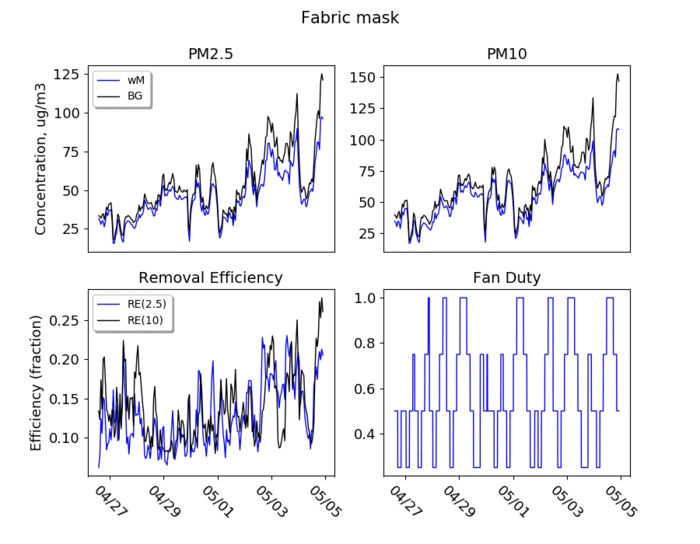
| Fabric | 8-14% | 8-14% |
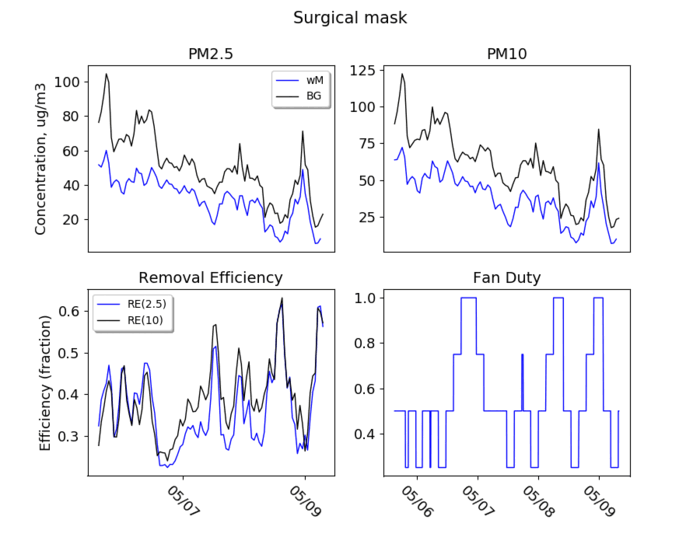
| Surgical | 29-39% | 29-39% |
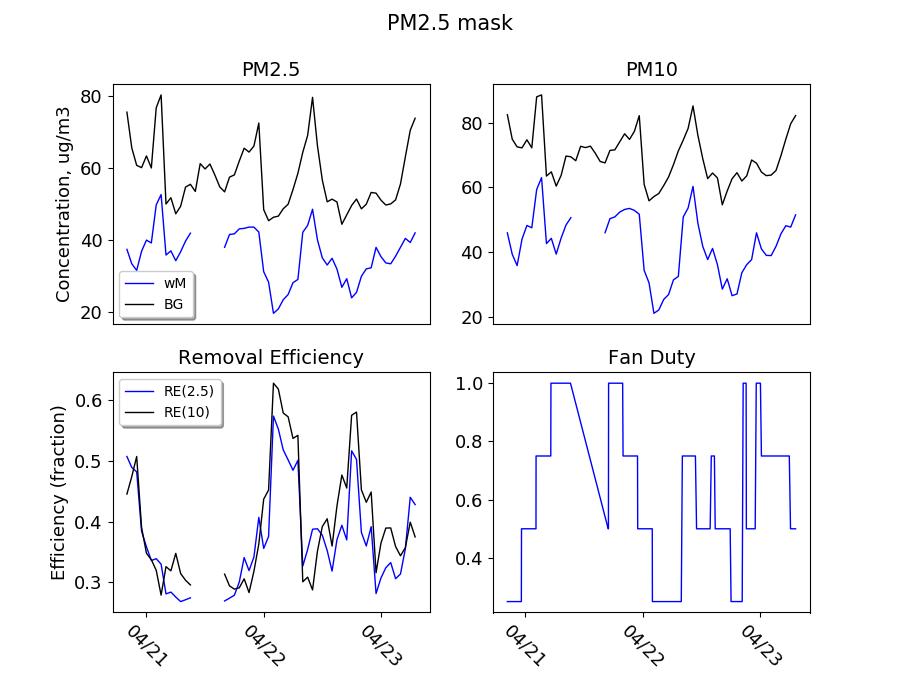
| Air mask (marketed) | 0-41% (inconsistent) | 0-41% |
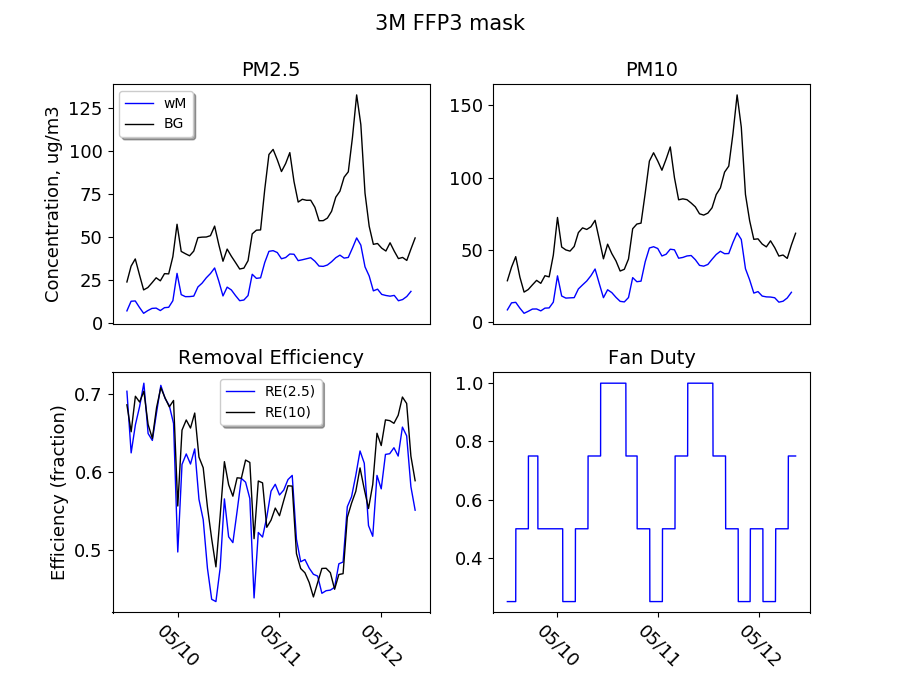
| 3M respirator (KN90/FFP3) | 47-62% | 52-62% |
| AQBlue / Airphin | 90-95% | 92-94% |
A negative correlation between airflow rate and RE (-0.76 to -0.89 for surgical and air masks) confirmed that higher flow reduces filtration. The 3M Aura showed a weaker correlation (-0.51), indicating design improvements that maintain RE at higher airflow.
Background
Hanoi’s 6 million motorbikes (10x the number of passenger cars) expose commuters to high PM$_{2.5}$ levels. By observation, 60-80% of riders wear masks, with fabric masks dominant. Yet fabric offers minimal protection against fine particles.
Previous work (Shakya et al., 2016) found fabric mask efficiency of 15-57% with diesel exhaust, while N95 respirators showed only marginal improvement over surgical masks for PM$_{2.5}$ specifically. The WHO reports 4.3 million annual deaths from indoor and 3.7 million from outdoor air pollution, with higher mortality in developing countries.
Analysis of US Embassy monitoring data (2016-2019) shows Hanoi meets Vietnam’s daily PM$_{2.5}$ standard (“good” level) only 26% of the time. By the WHO’s stricter 25 $\mu g/m^3$ daily limit (50% lower than Vietnam’s standard), the situation is worse.
Method
Apparatus
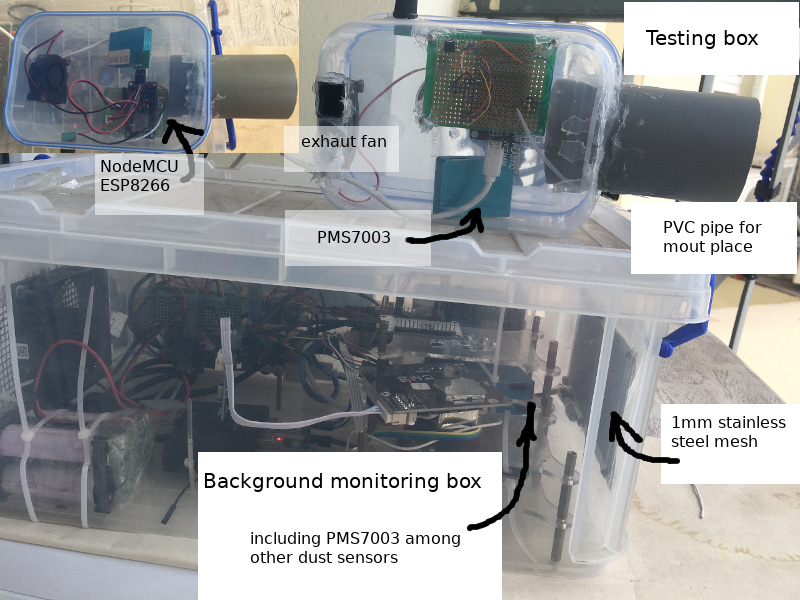
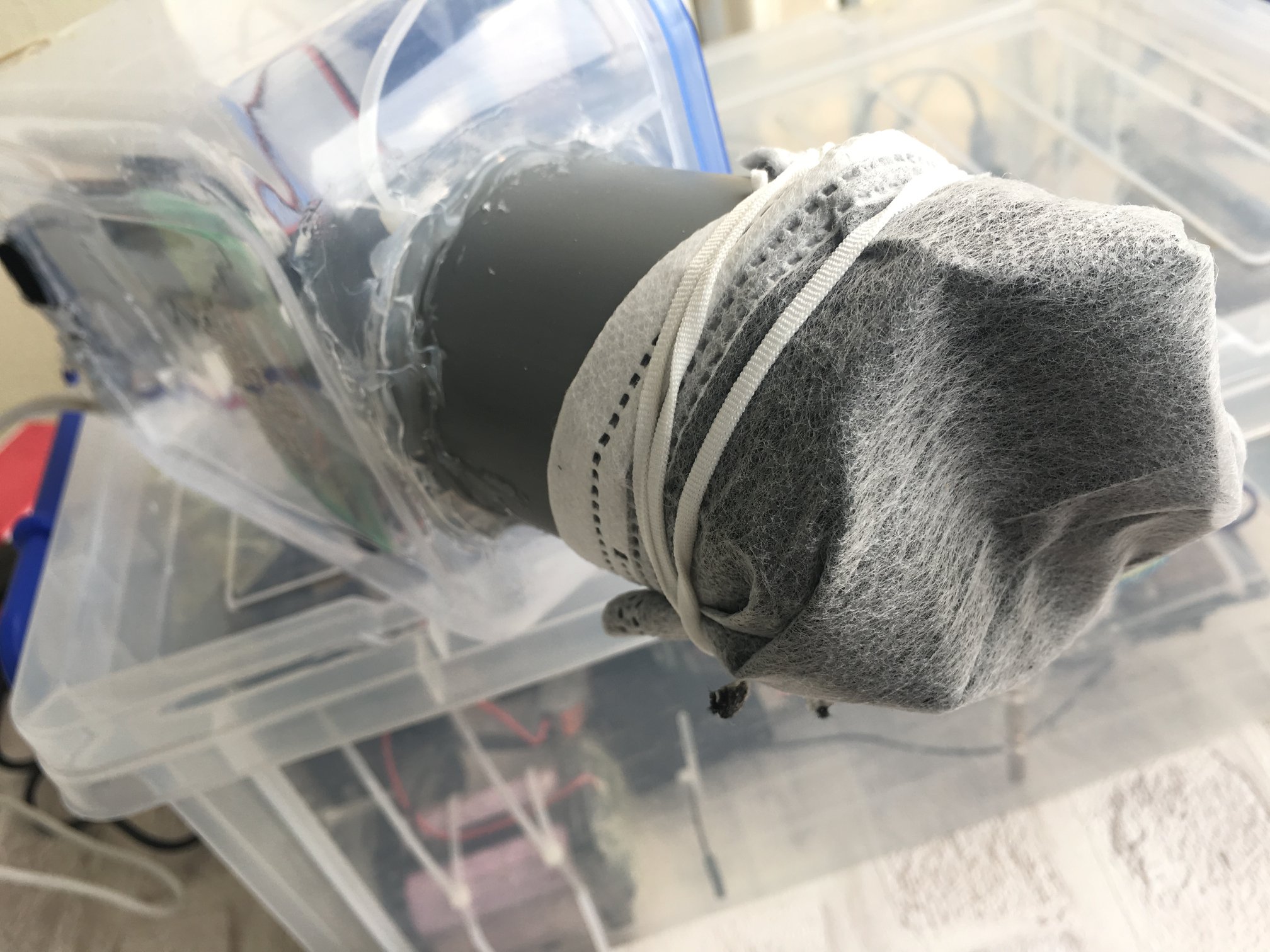
- Mask mounted flat on a 6 cm PVC pipe
- Fan with variable duty cycle (surrogate for airflow rate)
- Two PMS7003 sensors: one downstream of mask (filtered air), one measuring ambient background
- Location: 10th floor balcony, light ground-level traffic
- Each mask tested 2-6 days with 1-minute sampling interval
Data Processing
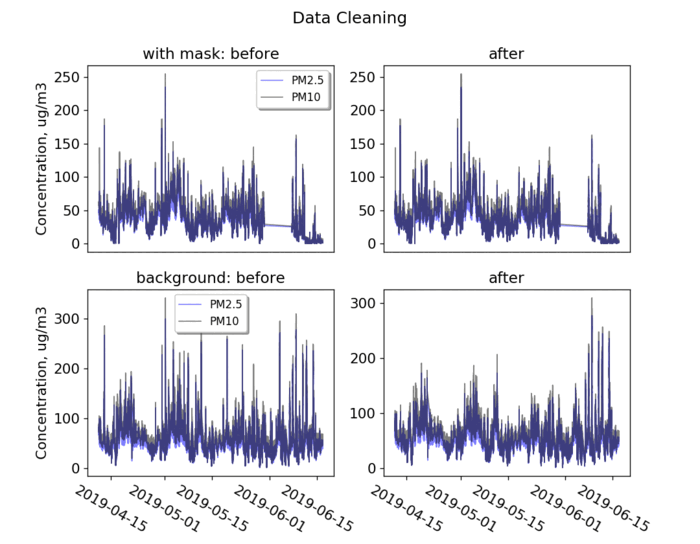
Over 45 days, ~65,000 data points collected per sensor. Cleaning steps:
- Removed single anomalous peaks (10 iterative rounds)
- 3.4% of mask data removed; 1.7% of background data removed
- Each experiment segmented into 90-120 min crosscheck (both sensors exposed to same air) followed by filtration period
Removal Efficiency Calculation
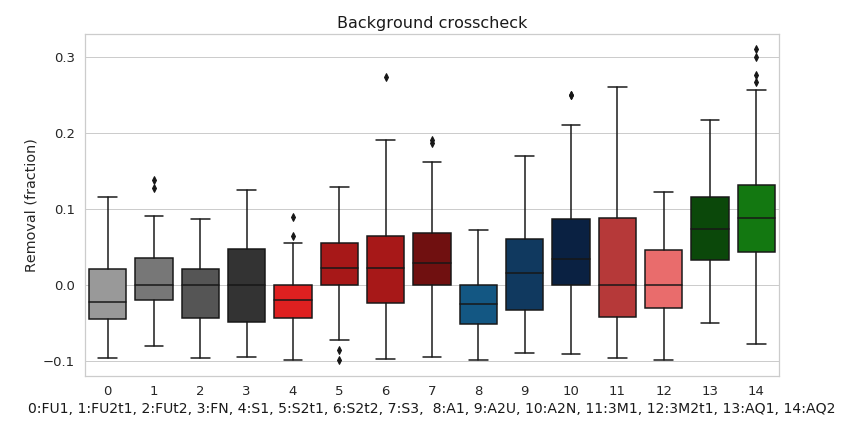
\[\text{RE} = \frac{\text{Background PM} - \text{Filtered PM}}{\text{Background PM}}\]Crosscheck periods confirmed sensor agreement (RE near zero when no mask mounted), validating the apparatus.
Results
All Masks
| Group | Mask ID | PM$_{2.5}$ RE | PM$_{10}$ RE | Fan Duty |
|---|---|---|---|---|
| Fabric | FU1 | 0.13 +/- 0.07 | 0.14 +/- 0.08 | 0.58 |
| Fabric | FU2 (#1) | 0.09 +/- 0.06 | 0.08 +/- 0.05 | 0.63 |
| Fabric | FU2 (#2) | 0.15 +/- 0.09 | 0.12 +/- 0.01 | 0.51 |
| Fabric | FN | 0.11 +/- 0.06 | 0.12 +/- 0.07 | 0.53 |
| Surgical | S1 | 0.29 +/- 0.12 | 0.29 +/- 0.13 | 0.58 |
| Surgical | S2 (#1) | 0.29 +/- 0.13 | 0.34 +/- 0.14 | 0.51 |
| Surgical | S2 (#2) | 0.33 +/- 0.06 | 0.33 +/- 0.08 | 0.55 |
| Surgical | S3 | 0.37 +/- 0.13 | 0.39 +/- 0.10 | 0.62 |
| Air mask | A1 | 0.03 +/- 0.06 | 0.03 +/- 0.08 | 0.53 |
| Air mask | A2N | 0.41 +/- 0.09 | 0.40 +/- 0.10 | 0.58 |
| Air mask | A2U | 0.37 +/- 0.10 | 0.39 +/- 0.11 | 0.61 |
| 3M | 3M1 (KN90) | 0.47 +/- 0.08 | 0.52 +/- 0.07 | 0.56 |
| 3M | 3M2 Aura (#1) | 0.57 +/- 0.09 | 0.59 +/- 0.09 | 0.60 |
| 3M | 3M2 Aura (#2) | 0.56 +/- 0.09 | 0.62 +/- 0.07 | 0.62 |
| 3M | 3M (old) | 0.51 +/- 0.09 | 0.52 +/- 0.09 | 0.56 |
| AQBlue | AQ1 | 0.94 +/- 0.04 | 0.94 +/- 0.04 | 0.60 |
| AQBlue | AQ2 | 0.92 +/- 0.05 | 0.92 +/- 0.04 | 0.62 |
Microscopy Observations
USB microscope images of mask construction revealed:
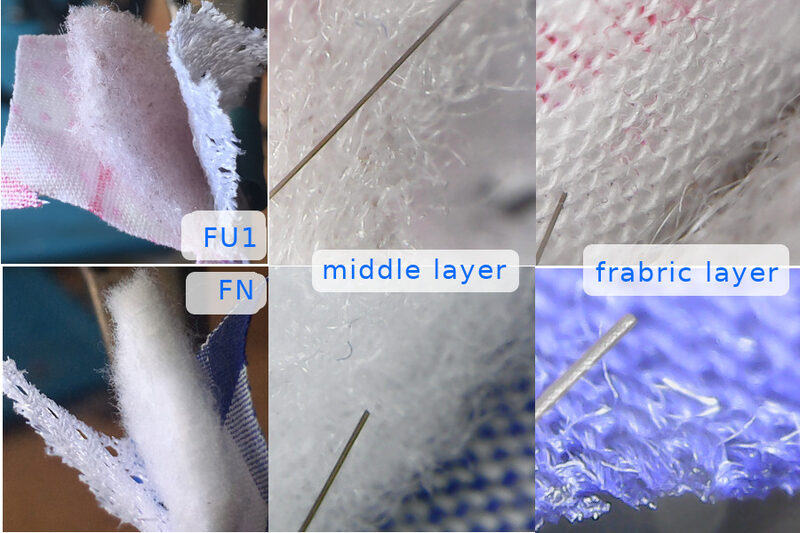
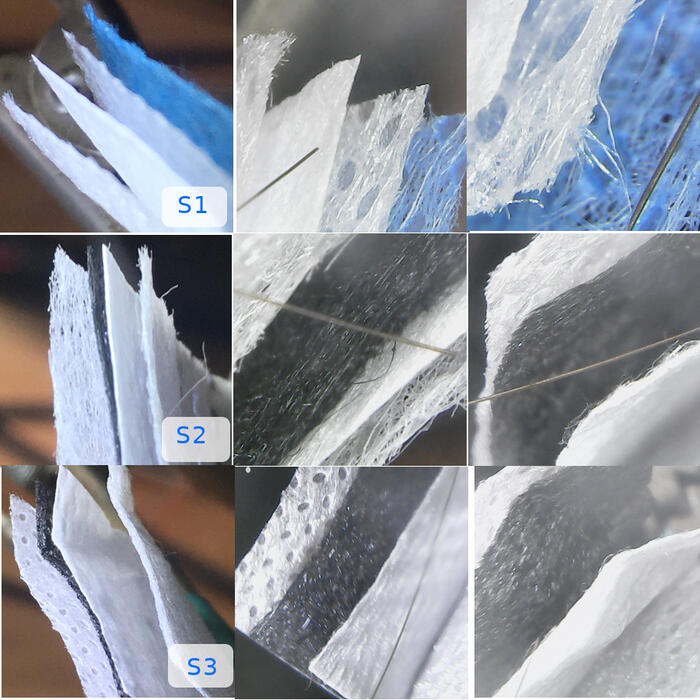
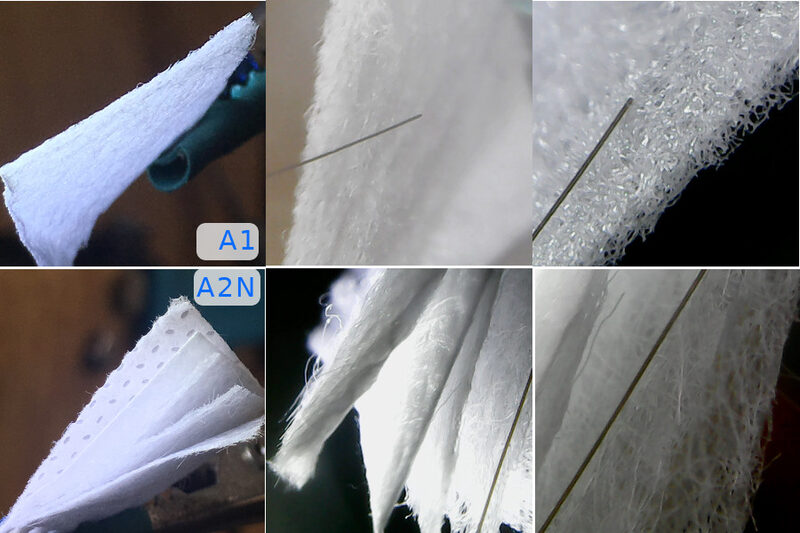
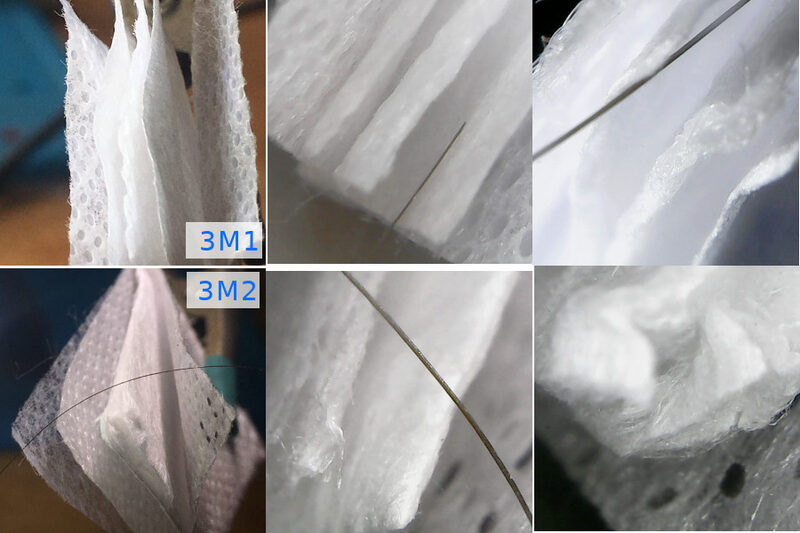
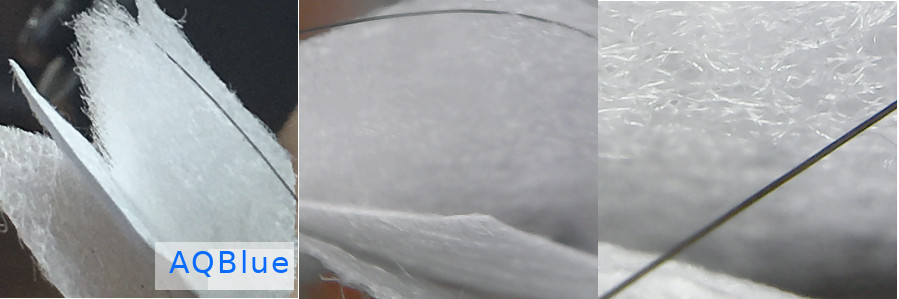
- Fabric: 3 layers (cotton outer, loose polyester middle, support inner). Middle layer loosely packed — visibly porous relative to PM$_{2.5}$ particle size.
- Surgical: 4-5 tightly packed layers. One middle layer composed of dense, fine fibers.
- Air mask A1: Single layer of randomly woven polyester. Pore size comparable to a human hair (~60-70 um) — roughly 30x larger than PM$_{2.5}$. No effective filtration.
- Air mask A2: 5 layers with fine fiber middle layer. Effective.
- 3M respirators: 5 layers. The Aura model features a thick, pillow-like middle layer; the 9001 has two fine-fiber middle layers.
Airflow vs. Removal Efficiency
| Mask Type | Correlation (fan duty vs. RE) | Interpretation |
|---|---|---|
| Fabric | Near zero | Too porous for meaningful filtration at any flow |
| Surgical | -0.76 to -0.89 | Strong negative: higher flow degrades RE significantly |
| Air mask | -0.76 to -0.89 | Same pattern as surgical |
| 3M Aura | -0.51 | Moderate negative: design allows higher airflow with less RE loss |
Limitations
-
No face-seal test. Masks were mounted flat on a pipe. Real-world leakage around the nose and cheeks reduces effective RE. Results represent maximum material filtration efficiency only.
-
Form factor varies by type. Surgical masks are not designed to seal around the face. Fabric masks conform better but use inadequate materials. Even a well-designed mask depends on individual facial geometry.
-
Not comparable to manufacturer ratings. Standard certification (NIOSH 42 CFR 84, EN 149, GB 2626) uses controlled aerosols and calibrated equipment. This study used ambient air and low-cost sensors, simulating on-road conditions rather than laboratory conditions.
-
Ambient testing location. A 10th-floor balcony with light ground traffic is an approximation of street-level exposure.
Conclusions
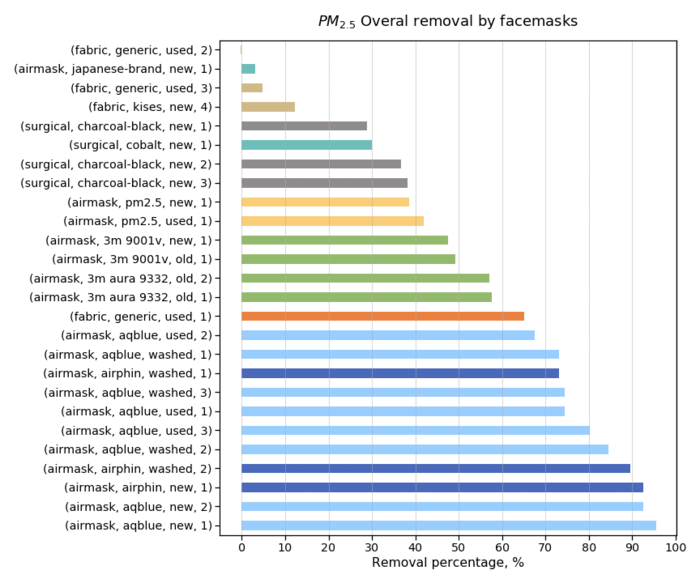
- Fabric masks (dominant on Hanoi streets) provide negligible PM$_{2.5}$ protection (8-14% RE)
- Surgical masks offer moderate filtration (29-39%) but poor face seal makes real-world benefit uncertain
- “Air masks” marketed for pollution are inconsistent — one model showed 0-3% RE, another 37-41%
- 3M particulate respirators (KN90/FFP3) achieved 47-62% material RE, with design features that resist degradation at higher airflow
- AQBlue respirators showed the highest RE at 90-95%
- Higher airflow consistently reduces RE, except for fabric masks (already too porous to filter)
- Choosing a certified brand-name mask and wearing it properly is the single most practical recommendation
Acknowledgements
Thanks to Dr. Han Huy-Dung for lending PMS7003 sensors, and to the SPARC lab at Hanoi University of Science and Technology for collaboration on sensor evaluation.
Originally published on b-io.info, 2019. 14 tests on 11 masks over a 55-day period.