Humidity: What It Means and How to Measure It
Concepts
Relative Humidity (RH)
The ratio of current water vapor mass to the saturation capacity at that temperature. Expressed as a percentage.
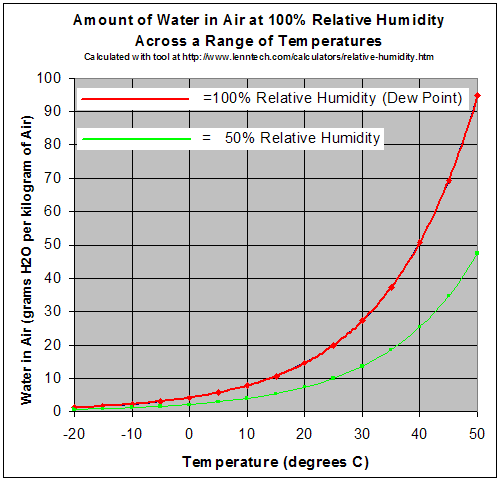 Warmer air holds more water. Same absolute moisture → lower RH at higher temperature.
Key insight: RH is calculated relative to temperature. When temperature rises and absolute vapor stays constant, RH drops because the air could hold more. This is why temperature and RH curves mirror each other:
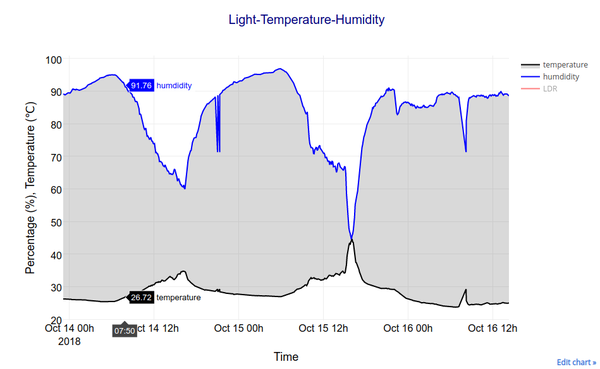 My weather station: temperature up → RH down, and vice versa. Not coincidence — it’s the definition.
Dew Point
The temperature at which air becomes saturated (RH reaches 100%) and condensation begins.
| Air condition | Dew point |
|---|---|
| 30°C, 70% RH | ~24°C |
| 30°C, 20% RH | ~4°C |
Heat Index
Perceived temperature combining air temperature and humidity:
| Temperature | RH | Feels like |
|---|---|---|
| 24°C | 0% | 21°C |
| 24°C | 50% | 24°C |
| 24°C | 100% | 27°C |
| 35°C | 70% | 46°C |
Why it matters: High humidity blocks sweat evaporation — the body’s primary cooling mechanism. In Hanoi summers (35°C, 80% RH), heat stress is a real risk.
Conversely, very dry air causes cracked skin, nosebleeds, and respiratory irritation by drawing moisture from exposed tissue.
Sensor Selection
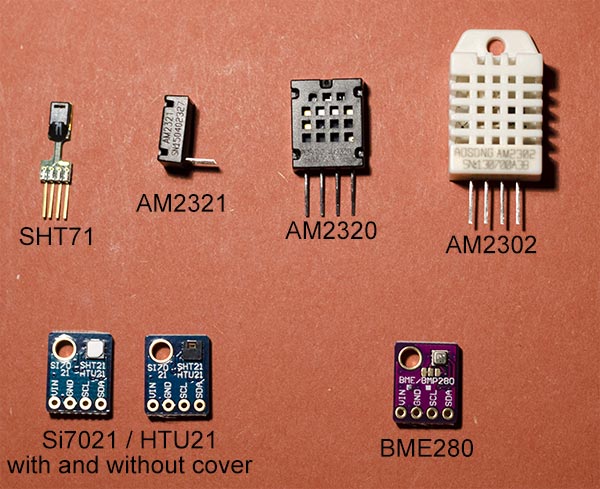 Capacitive sensor comparison by Robert Kandrsmith. Accurate range: ±3% within 10-80% RH. Above 80%, accuracy degrades significantly.
Sensors Tested
| Sensor | Type | Interface | Accuracy | Price |
|---|---|---|---|---|
| SHT3x (Sensirion) | Capacitive | I2C | ±2% RH, ±0.2°C | ~$5 |
| BME280 (Bosch) | Capacitive | I2C/SPI | ±3% RH | ~$4 |
| HDC1080 (TI) | Capacitive | I2C | ±2% RH | ~$4 |
| Si7021 | Capacitive | I2C (0x40) | ±3% RH | ~$3 |
| DHT22 / AM2302 | Resistive | One-wire | ±2-5% RH | ~$3 |
Measurement Principles
- Capacitive: polymer film absorbs water vapor, changing dielectric constant → capacitance change. Most modern sensors use this.
- Resistive: ceramic substrate changes resistance with moisture absorption. Older technology, less accurate.
- Gravimetric: (reference only) weigh absorbed water directly.
Practical Notes from Hanoi
Problem: Hanoi regularly hits 80-90% RH. Most sensors are specified for ±3% accuracy in the 10-80% range. Above 80%, readings drift unpredictably.
I2C address conflicts: Si7021 and HTU21D both use 0x40 with no option to change. Cannot use both on the same bus. Discovered this after ordering both — always check the address table first.
Duplicate sensors help: Running Si7021 + DHT22 on the same station reveals when one drifts. Average them for a better estimate.
Power supply matters: MCP1700 LDO provides clean 3.3V. Noisy supply → noisy readings, especially for the ADC-based DHT22.
Condensation kills readings: At 100% RH (dew point = air temp), condensation forms on the sensor element. Some sensors have built-in heaters to prevent this. The BME280’s internal heater is meant for this purpose.
Application: When Does Humidity Matter?
| Context | Why RH matters |
|---|---|
| Air quality (PM sensors) | High RH inflates light-scattering readings — particles appear larger |
| Weather station | Core measurement for comfort index, dew point alerting |
| Electronics enclosure | Condensation at >95% RH can short circuits |
| Gravimetric analysis | Must account for water content in weighed samples |
| Agriculture | Crop disease risk correlates with leaf wetness (high RH + temperature) |
Notes from operating weather stations in Hanoi, 2018-2019.