Temperature: Shaded vs Direct Sunlight
Measuring air temperature sounds trivial — until your sensor reads 45°C on a 32°C day because the sun hit the enclosure. These are practical observations from running an outdoor weather station on a west-facing balcony in Hanoi.
The Problem
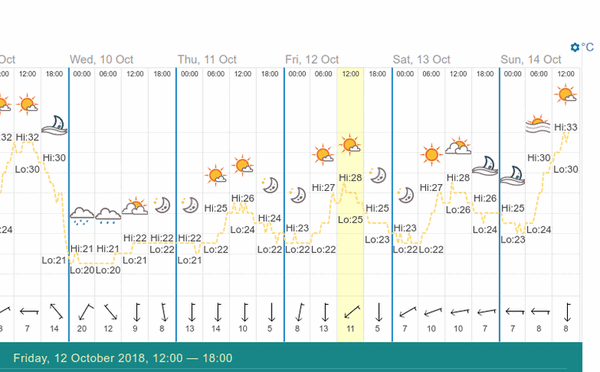 Reference: official temperature data shows smooth, symmetrical daily curves centered around solar noon.
Under clear skies, air temperature rises symmetrically with solar radiation, peaking near noon. Clouds shift and dampen the peak. This is what a properly shaded thermometer produces.
My weather station, however, showed something different:
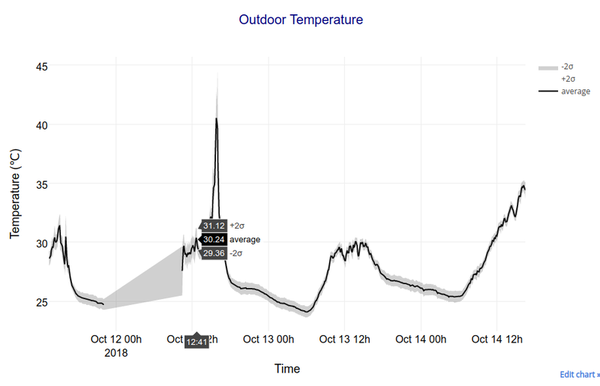 My station: needle-shaped spikes at 3-4 PM when direct afternoon sun hits the west-facing sensors.
The west-facing balcony receives direct sunlight from approximately 3-4 PM. The enclosure heats up, and the sensors record enclosure temperature rather than ambient air temperature.
Proving the Cause
Is it really sunlight? Or sensor drift, or electrical noise?
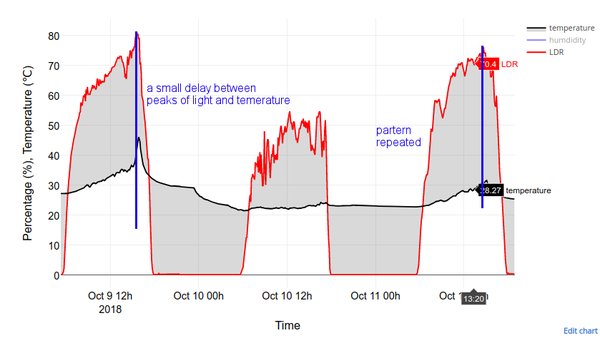 Light sensor (LDR) data confirms: peak light intensity directly precedes the temperature spike, with a thermal lag from heating the enclosure.
The delay between light peak and temperature peak is physical — it takes time to heat the box, and longer to cool it. On cloudy days (Oct 13 in the graph), the spike is absent and the curve is symmetrical.
Self-Heating
Beyond sunlight, sensors themselves generate heat during operation:
| Source | Magnitude | Mitigation |
|---|---|---|
| ESP8266 operation | Minimal (deep sleep mode) | Deep sleep between readings |
| Li-ion charging | Detectable by sensors | Separate charging circuit from sensor compartment |
| Sensor excitation current | ~0.1-0.5°C | Duty-cycle readings, don’t leave powered continuously |
In the data, a 1.5-hour battery charging event produced a visible temperature bump — the charging heat propagated to nearby sensor probes.
Sensor Types Used
| Sensor | Principle | Accuracy | Self-heating |
|---|---|---|---|
| DS18B20 (x2) | Direct-to-digital (Dallas patent) | ±0.5°C | Minimal |
| DHT22 | Thermistor + ADC | ±0.5°C | Low |
| SHT21 | Silicon bandgap | ±0.3°C | Low |
| BME280 | MEMS | ±0.5°C | Moderate (internal heater for pressure) |
My station averages 4 independent sensors (2x DS18B20, DHT22, SHT21) to reduce individual bias and detect outliers.
Practical Guidelines
- Shade the sensors — a radiation shield or north-facing mount eliminates the biggest error source
- Use deep sleep — minimize self-heating from the MCU
- Separate power circuits — battery charging generates enough heat to bias nearby sensors
- Average multiple sensors — 3-4 independent sensors catch drift and identify outliers
- Log light intensity alongside temperature — makes artifacts identifiable in post-processing
- Accept imperfection — even with these precautions, a balcony station will never match an official shaded instrument shelter
Observations from a west-facing 10th-floor weather station in Hanoi, 2018.