PM Measurement Methods
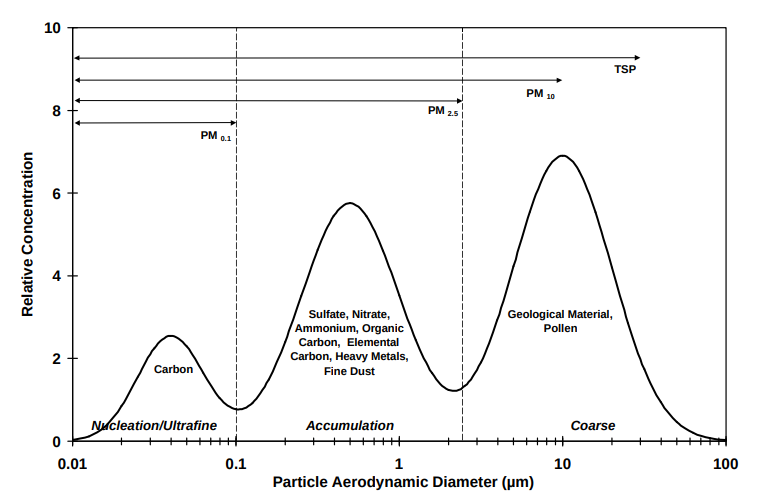 EPA Report Fig. 2.4: Particle size ranges by origin. Construction dust → PM100, combustion soot → PM2.5, secondary aerosols → ultrafine.
Sources of Particulate Matter
| Source | Mechanism | Resulting PM |
|---|---|---|
| Construction sites | Wind sweeps fine sand/dust | PM10-PM100 |
| Diesel engines | Carbon soot (incomplete combustion) | PM2.5, ultrafine |
| Gasoline engines | Secondary Organic Aerosol (SOA) | PM2.5 (5x more than primary) |
| Coal combustion | SO2 → sulfate conversion | PM2.5 |
| Agricultural burning | Direct emission | PM2.5 |
| Fertilizer volatilization | NH3 + NOx → ammonium nitrate | PM2.5 |
Measurement Techniques
1. Gravimetric (Reference Method)
Weigh a filter before and after drawing ambient air through it for a fixed period. The gold standard — all other methods are validated against this.
2. Beta Attenuation Monitor (BAM)
Measures the loss of beta particles (electrons from 14C source) passing through a loaded filter vs a blank. Used by the US Embassy in Hanoi (MetOne BAM-1020). Federal Equivalent Method (FEM) certified for continuous hourly monitoring.
3. Tapered Oscillating Microbalance (TOEM)
Particles collected on a filter change the oscillation frequency of a tapered element. Frequency shift → mass calculation. Continuous measurement.
4. Piezoelectric Microbalance
Quartz crystal resonance frequency changes with deposited mass. Compare loaded crystal vs control crystal.
5. Pressure Drop Sampler
Dust on a filter increases headloss. Measure pressure differential over time.
6. Light Scattering (Nephelometer)
Illuminates particles with a light beam; measures scattered light intensity in all directions. Basis for many ambient monitoring networks.
7. Optical Particle Counter
Counts and sizes individual particles by the light pulse each produces. This is how low-cost sensors (PMS7003, SDS011) work — a laser illuminates particles in a chamber, and a photodetector counts scattered pulses.
8. Condensation Nuclei Counter
For ultrafine particles too small for optical detection: grow them by condensation (alcohol vapor), then count by scattering.
9. Aerodynamic Particle Sizer
Combines light scattering with time-of-flight measurement to determine both particle count and aerodynamic diameter.
10. LIDAR (Light Detection and Ranging)
Pulsed laser sent upward; backscattered light measured by a co-located receiver. Provides vertical column profile of aerosol loading.
Effect of Humidity on Light Scattering
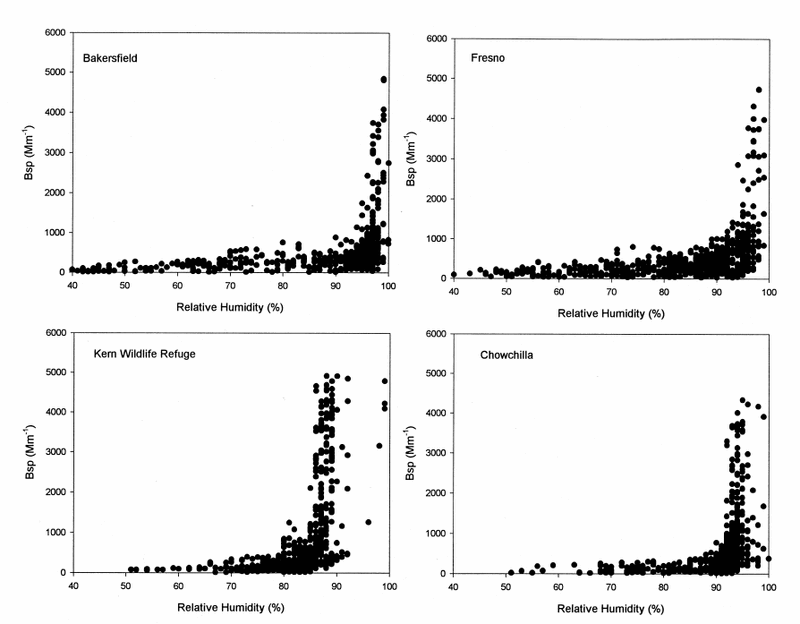 EPA Report Fig. 4.8: High relative humidity inflates light-scattering readings. This is why low-cost sensors overestimate PM in humid conditions (Hanoi: 80-90% RH typical).
Water vapor condenses on particle surfaces, increasing their apparent size and scattering cross-section. Sensors without a heated inlet or RH correction systematically overread in tropical climates.
Regulatory Standards
Vietnam
- QCVN 05:2013/BTNMT — National Technical Regulation on Ambient Air Quality
- Sampling methods: TCVN 5067:1995 (gravimetric), TCVN 9469:2012 (BAM)
- Vietnam updated AQI calculation to breakpoint method in Nov 2019 (Decision 1459/QD-TCMT)
United States
- CFR § 50.7 — defines reference and equivalent methods for PM2.5
- FRM (Federal Reference Method) — gravimetric, 24-hour integrated
- FEM (Federal Equivalent Method) — BAM, TOEM for continuous monitoring
- Method 201A: determination of PM10/PM2.5 from stationary sources
Monitoring Equipment in Hanoi
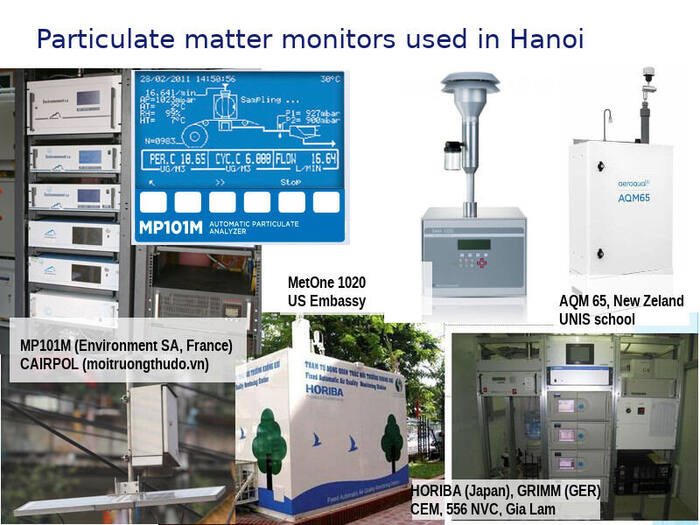 Range of instruments: research-grade stationary monitors to $13 laser-scattering sensors.
| Station | Equipment | Method | Data |
|---|---|---|---|
| Chi Cuc (VN MONRE) | Environment SA MP101M | Regulatory multi-pollutant | Limited public access |
| US Embassy | MetOne BAM-1020 | FEM, hourly PM2.5 | Public via AirNow |
| SPARC Lab (HUST) | Various low-cost | Research collocation | Academic |
| My projects | PMS7003, SDS011 | Laser scattering | See study |
Low-Cost Sensors
| Sensor | Price | Output | Lifespan | Notes |
|---|---|---|---|---|
| PMS7003 (Plantower) | ~$13 | PM1/2.5/10 + 6 size bins | 8,000h | Best value, small, rich data |
| SDS011 (Nova Fitness) | ~$19 | PM2.5, PM10 (float) | 8,000h | Remote air intake via hose |
| HPMA115S0 (Honeywell) | ~$19 | PM2.5, PM10 (int) | 20,000h | Best documentation |
| Dylos DC1100 Pro | ~$290 | Particle count (2 bins) | Years | Reference for hobbyists |
Notes from building air quality monitoring systems, 2018-2019.