Solar Irradiance Meter
A simple setup to measure solar power density using a mini photovoltaic cell as the sensing element. Total cost: under $10.
How It Works
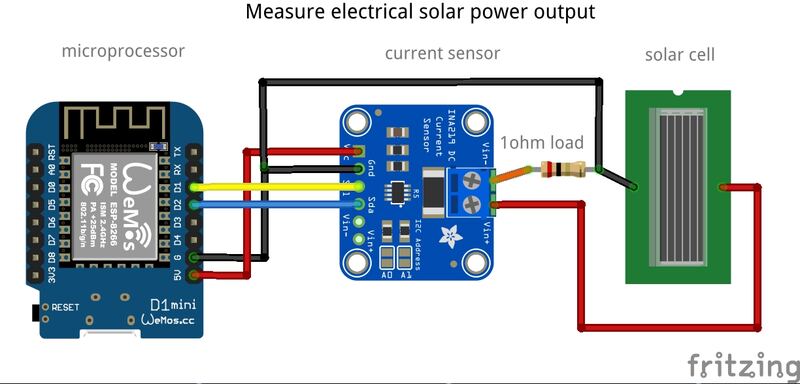 INA219 current sensor reads voltage (V) and current (I) across a 1-ohm load connected to a mini solar cell.
The INA219 measures current (mA) and voltage (V) through a fixed load resistor. Solar power density:
P (W/m²) = (I × V) / area_of_solar_cell
The solar cell converts photon energy into electrical energy. By measuring the electrical output across a known load, we infer the irradiance hitting the cell.
Parts
| Component | Purpose | Cost |
|---|---|---|
| Mini solar cell | Photon-to-electron conversion | ~$2 |
| INA219 breakout | Measures V and I via I2C | ~$3 |
| 1-ohm precision resistor | Fixed load | ~$0.50 |
| ESP8266/Arduino | ADC + data logging | ~$3 |
 |  |
|---|---|
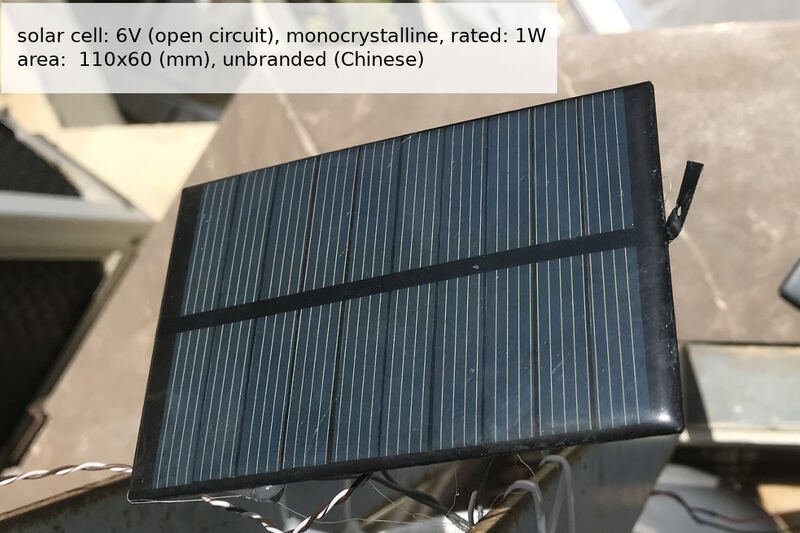
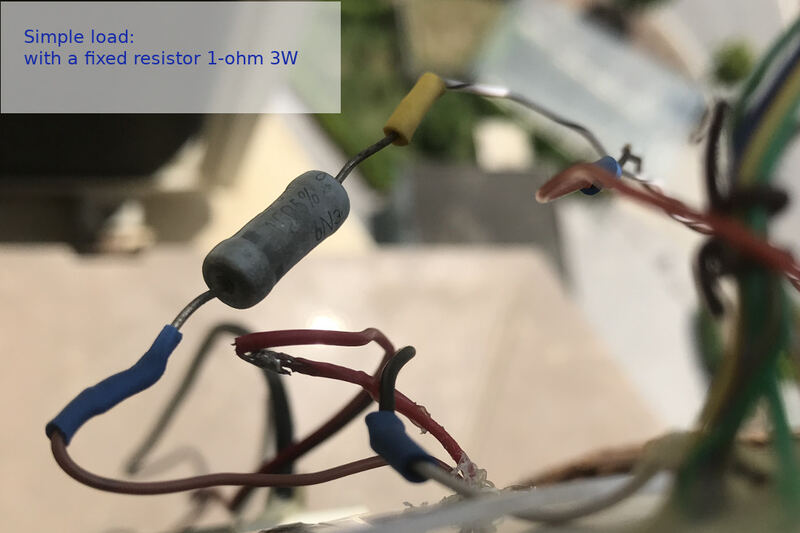
| Mini solar cell as irradiance sensor | 1-ohm precision resistor as load |
Energy Conversion Chain
From photon hitting the solar cell to usable stored energy, losses occur at every stage:
| Stage | Typical efficiency | Notes |
|---|---|---|
| Photon → electron (PV cell) | 20-25% (commercial) | Lab records >40% (NREL). My mini cell likely 15-18% |
| DC → regulated DC (charge controller) | 85-95% | MPPT is optimal; PWM loses more |
| Wiring + connectors | 95-99% | Minimize wire length and joints |
| Battery charging | 90-95% | Internal resistance → heat loss |
| Temperature derating | -0.3%/°C above 25°C | Black cells in direct sun get hot |
| Tilt angle | Varies | Optimal angle ≈ latitude for annual max |
Design Choices
Why a fixed 1-ohm resistor instead of a real battery?
The 1-ohm approximates battery internal resistance, giving a repeatable, temperature-stable load. A real battery’s internal resistance changes with charge state, age, and temperature — making the measurement harder to interpret.
Location matters:
My setup faces west — direct sunlight from noon to afternoon, diffused morning light only. The measurement represents direct normal irradiance (DNI) during afternoon and global horizontal irradiance (GHI) in the morning.
Calibration:
Without a reference pyranometer, absolute accuracy is limited. But relative measurements (today vs yesterday, morning vs afternoon, clear vs overcast) are reliable and useful for:
- Solar panel site evaluation
- Cloud cover detection
- Light-driven control triggers (turn on irrigation when >X W/m²)
Data Interpretation
| Reading | Condition | Typical output |
|---|---|---|
| 800-1000 W/m² | Direct midday sun, clear sky | Maximum — close to solar constant |
| 200-500 W/m² | Overcast or angled | Diffused radiation only |
| 50-100 W/m² | Heavy cloud or dawn/dusk | Minimal useful power |
| 0 | Night | Baseline noise check |
Hanoi has ~1,500-1,700 sunshine hours/year (lower than tropical average due to winter drizzle). Peak irradiance occurs March-September.
Built as part of a weather station project, September 2020.