Turbidostat: Open-Source Biomass Density Control for Microalgae
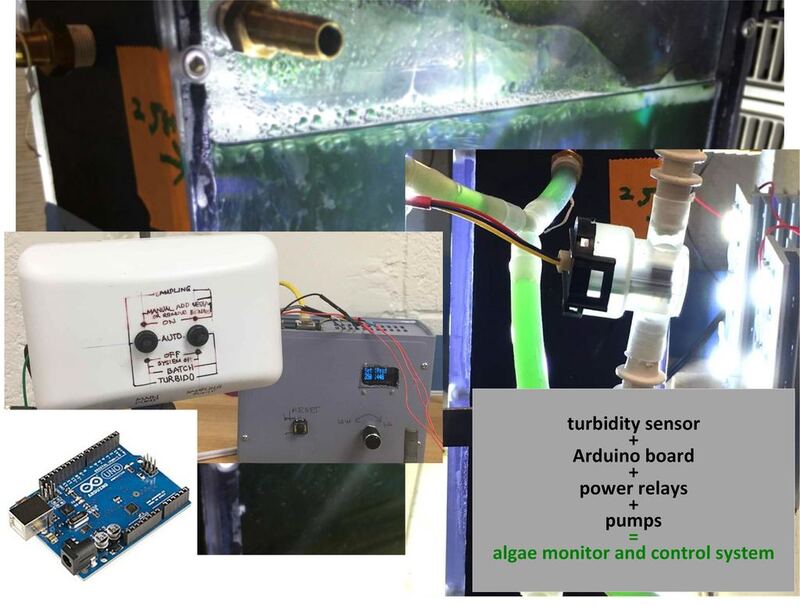
This system was developed at the Biodesign Swette Center for Environmental Biotechnology, Arizona State University. The scientific contribution was published in Algal Research (2018). Total hardware cost: ~$200 (excluding the lab-grade peristaltic pump).
What is a Turbidostat?
A turbidostat maintains microalgae culture at a constant density by continuously monitoring turbidity (optical density) and diluting with fresh medium when the culture grows too dense. Think of it as a thermostat, but for biomass concentration instead of temperature.
Commercial turbidostat systems cost $10,000+. This open-source build achieves the same function for ~$200 using a $15 turbidity sensor and an Arduino.
The Problem
Measuring microalgae biomass typically requires a laboratory spectrophotometer — expensive, manual, and limited to one sample at a time. For continuous cultivation experiments (days to weeks), an automated, low-cost system that monitors and controls density in real-time is essential.
The target organism was Synechocystis sp. PCC 6803, a sub-micron cyanobacterium that converts light energy and CO2 into biomass. The challenge: finding an affordable sensor that works with these very small cells.
Design
Concept
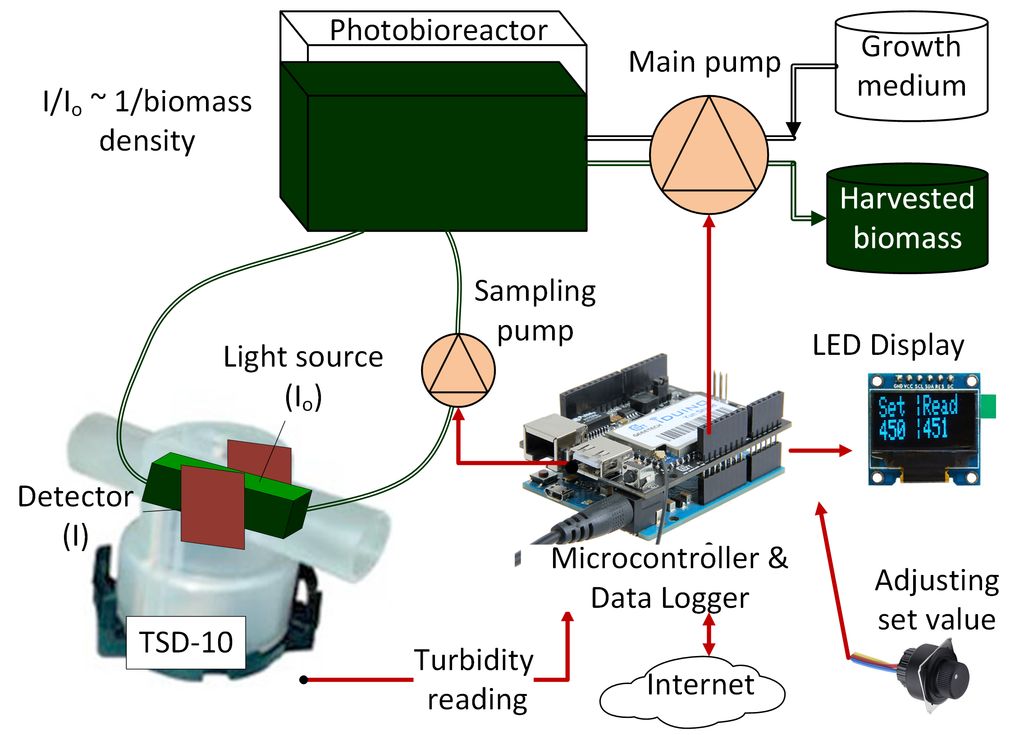 Core concept: turbidity sensor reads culture density → Arduino compares to setpoint → activates dilution pump when density exceeds threshold.
Key Components
| Part | Purpose | Cost |
|---|---|---|
| TSD-10 turbidity sensor (Amphenol) | Infrared light transmission through culture | ~$15 |
| Arduino Mega | Sensor reading, control logic, pump switching | ~$20 |
| Op-amp breakout | Amplify sensor signal | ~$5 |
| Precision potentiometer (10-turn) | Set target density | ~$5 |
| OLED display (SSD1306) | Real-time readout | ~$5 |
| 2-channel relay board | Switch pumps on/off | ~$5 |
| Peristaltic pump (12V) | Dilution delivery | ~$30 |
| Yun Shield OR Raspberry Pi | Timestamp + data logging | ~$35 |
| Three-position switches (x2) | Manual override control | ~$5 |
Schematic
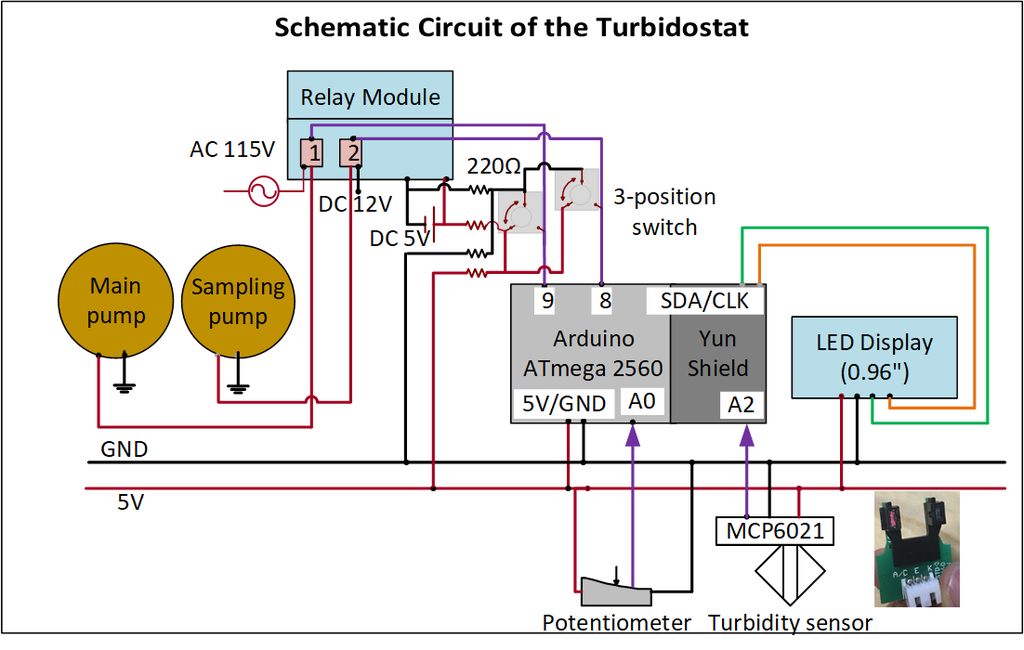 Wiring: turbidity sensor → op-amp → Arduino ADC. Arduino drives relay board controlling pumps. Potentiometer sets density threshold.
Control Logic
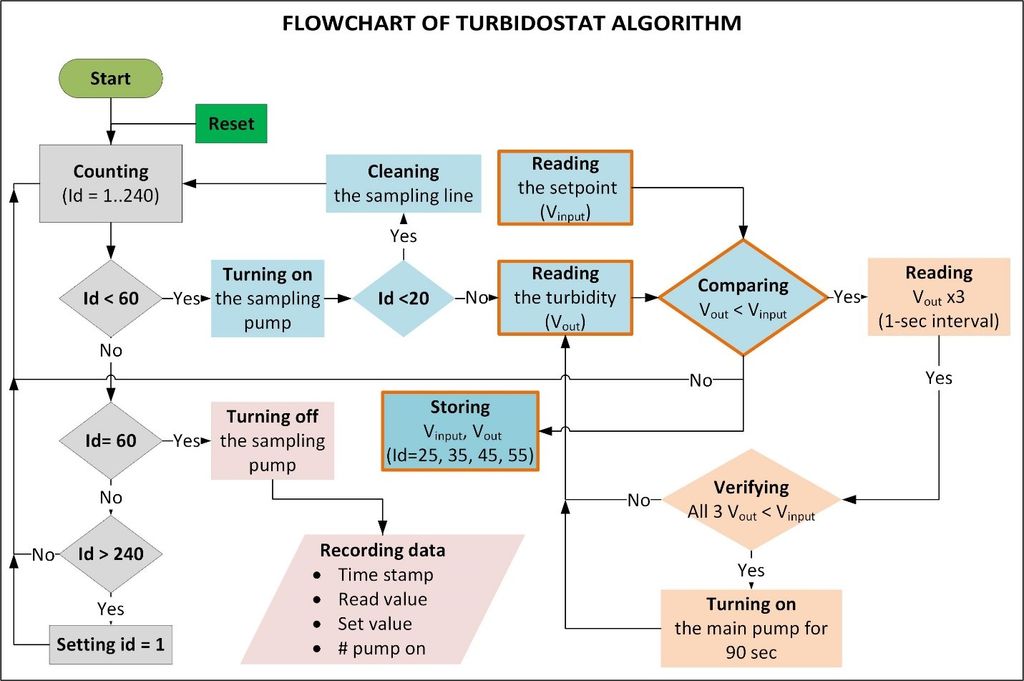 Execution sequence: count interval → flush sampling line → read sensor → compare to setpoint → pump on/off → log data.
Sensor Performance
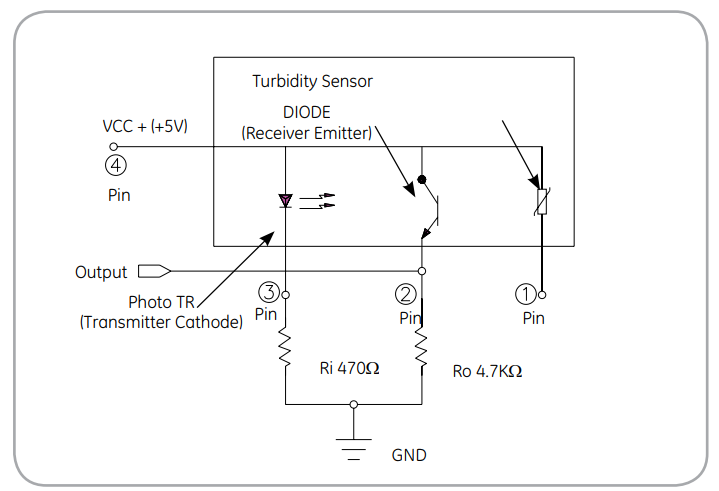 TSD-10 uses infrared LED emission and a photodetector. Designed for washing machines, but works well for microalgae in the OD 0.1-2.0 range.
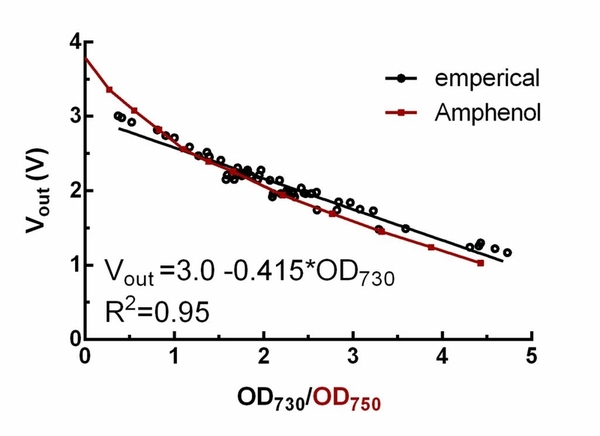 Conversion of raw voltage readout to optical density (OD730 and NTU). Higher voltage = less light absorbed = lower density.
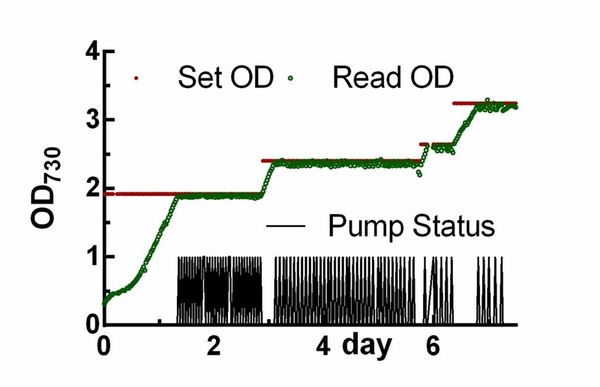 Working system: culture density (green) tracks the setpoint (red). Pump status shows dilution events triggered when density exceeds threshold.
Data Logging
Two options were implemented:
Option 1: Yun Shield (Linux on Arduino)
The Yun Shield provides WiFi, USB, and SD card storage with a Linux timestamp. Data logged to microSD in CSV format.
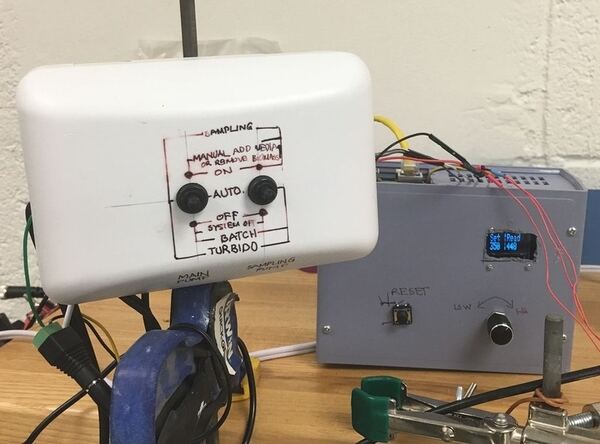
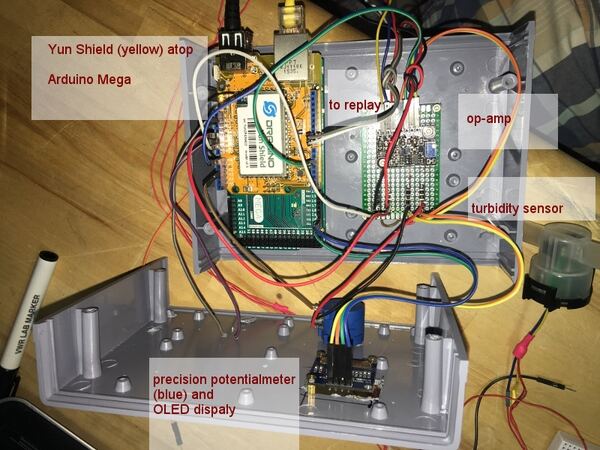 Version 1.0: Yun Shield + Arduino Mega + op-amp in a project box.
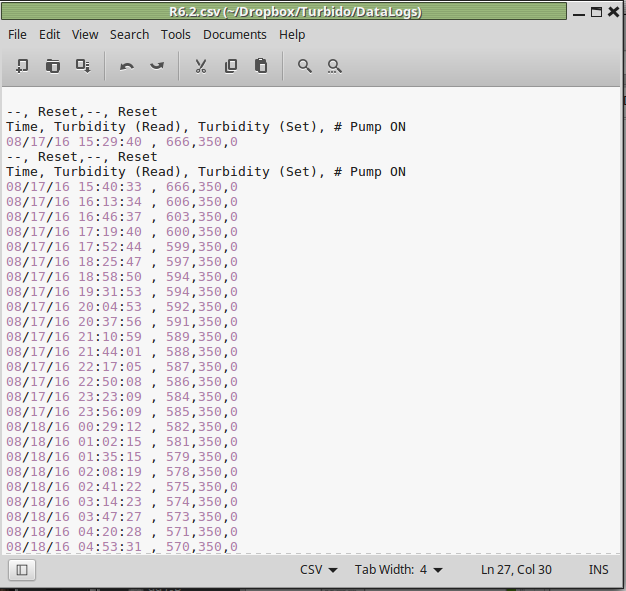 CSV data: timestamp, turbidity reading, setpoint, pump status.
Option 2: Raspberry Pi
Arduino sends Serial.print() data over USB; a Python script on the Pi captures, timestamps, and saves to file.
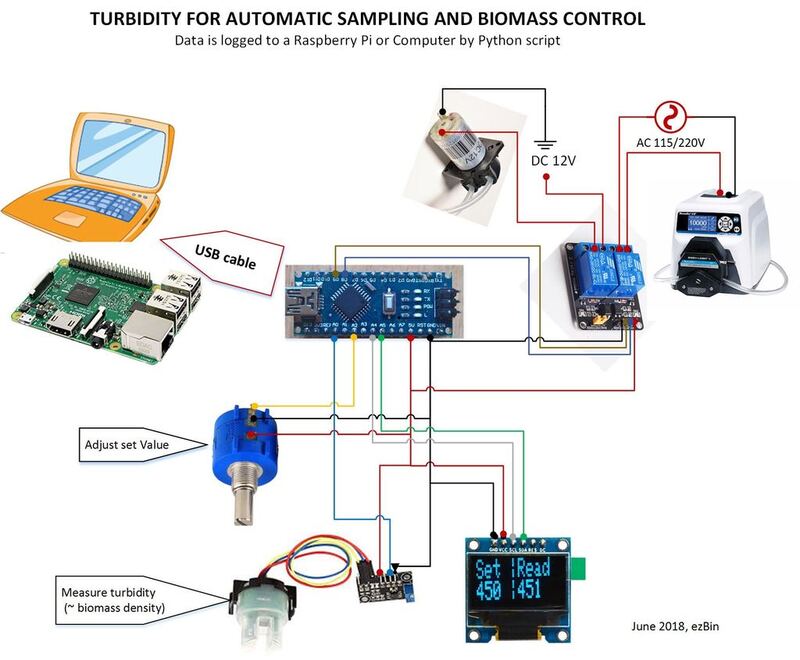 Simplified data path: Arduino → USB serial → Python script → timestamped CSV.
// Arduino sends this every 60 seconds:
String dataString = "";
averageRead = round((read25+read35+read45+read55)/4);
dataString += String(averageRead) + "," + String(setValue) + "," + String(_pumpON);
Serial.println(dataString);
Hardware Photos
 |  |
|---|---|
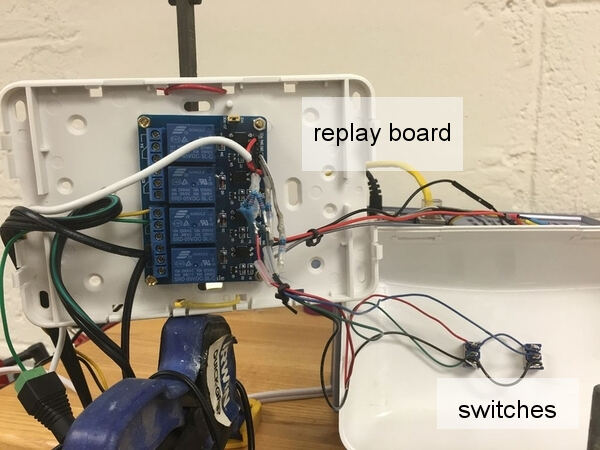
| Relay board for pump switching | Control box (Version 1.0) |
 |  |
|---|---|
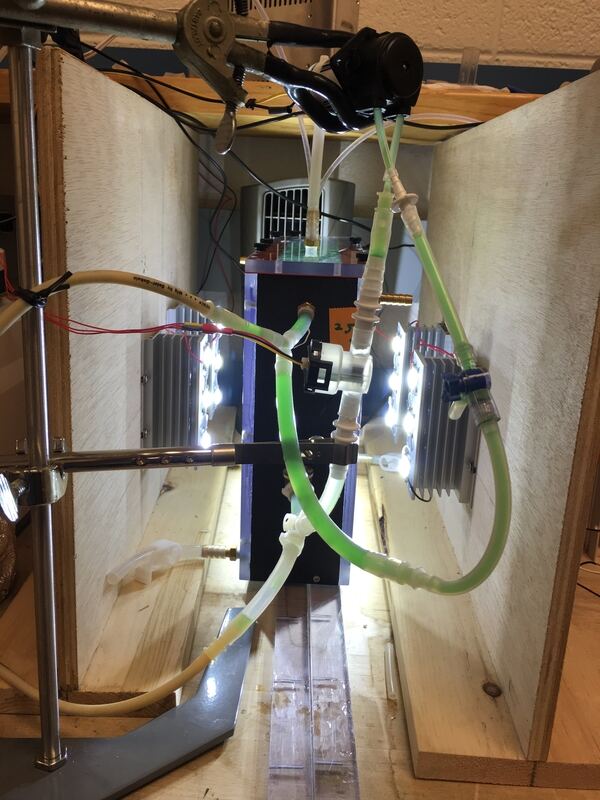
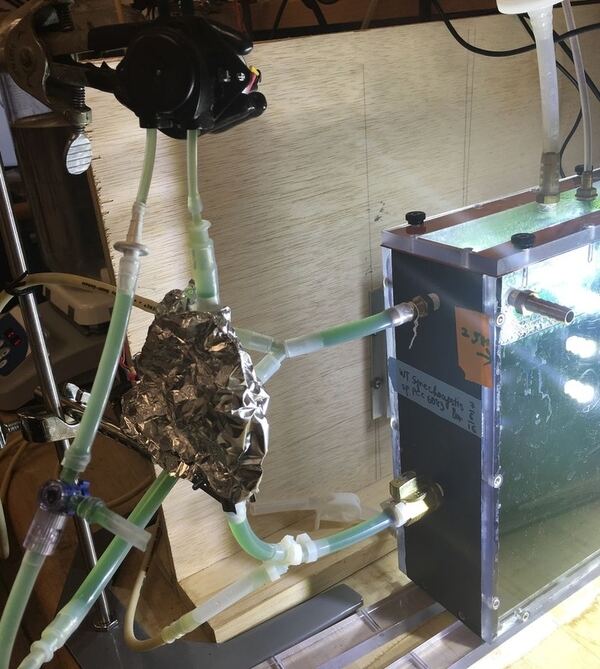
| Turbidity sensor sampling from reactor | Sensor wrapped in foil to block ambient light |
 |  |
|---|---|
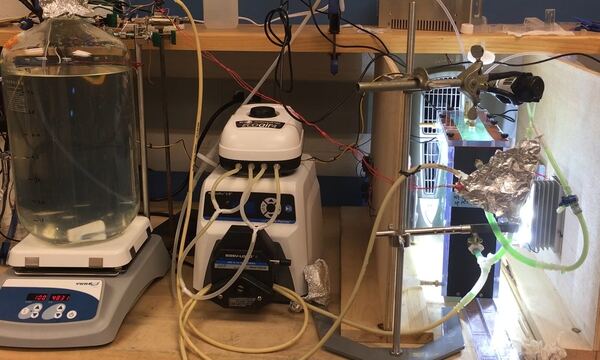
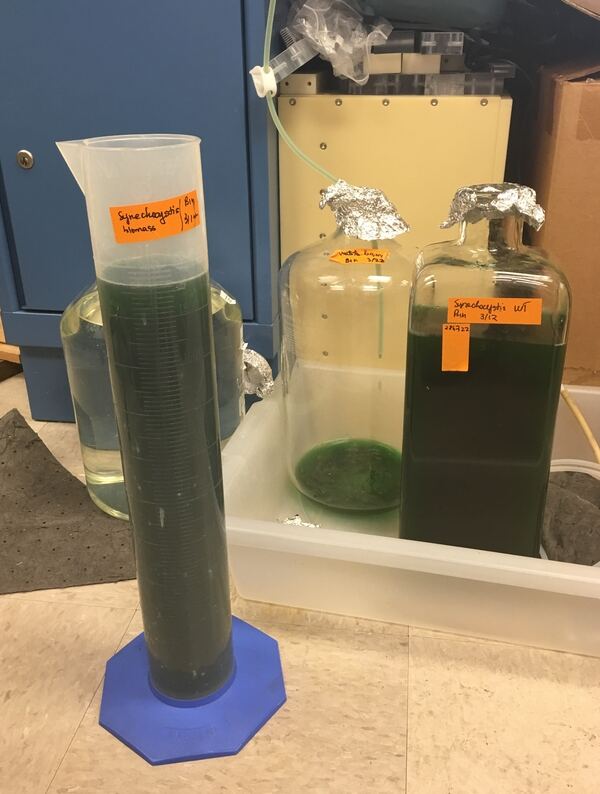
| Complete photobioreactor with turbidostat | Harvested microalgae from hold-up tank |
Publication
This turbidostat is one of three open-hardware units developed for an advanced photobioreactor system. The scientific contribution — demonstrating that a $200 system can replace $10,000+ commercial alternatives for continuous microalgae cultivation — was published in:
Algal Research (2018) DOI: 10.1016/j.algal.2018.03.013
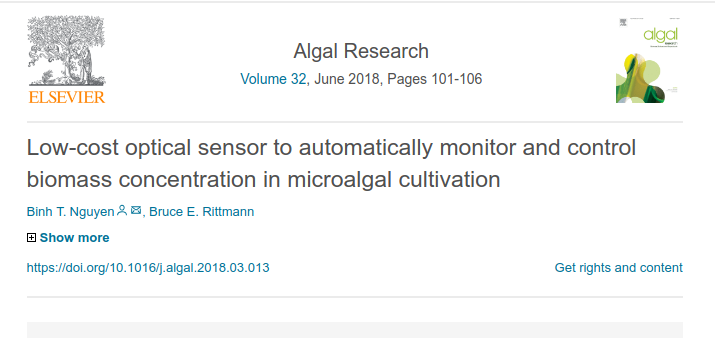
The paper covers:
- Validation of low-cost turbidity sensing against laboratory spectrophotometer
- Long-term continuous cultivation results
- Open hardware design enabling reproducibility
- Cost comparison with commercial systems
Source Code
- Arduino (Yun Shield): Turbidity_logdat_YunShield_2018
- Arduino (RPi logging): Turbidity_log_python
- Python data capture: serial_logger.py
Key Takeaways
- A $15 washing-machine turbidity sensor works for microalgae optical density measurement
- Total system cost ~$200 vs $10,000+ for commercial alternatives
- Arduino + relay + peristaltic pump = automated density control
- Two data logging options: embedded Linux (Yun Shield) or Raspberry Pi with Python
- Published validation in peer-reviewed journal confirms scientific utility
Developed at Biodesign Swette Center for Environmental Biotechnology, Arizona State University. Published 2018.